
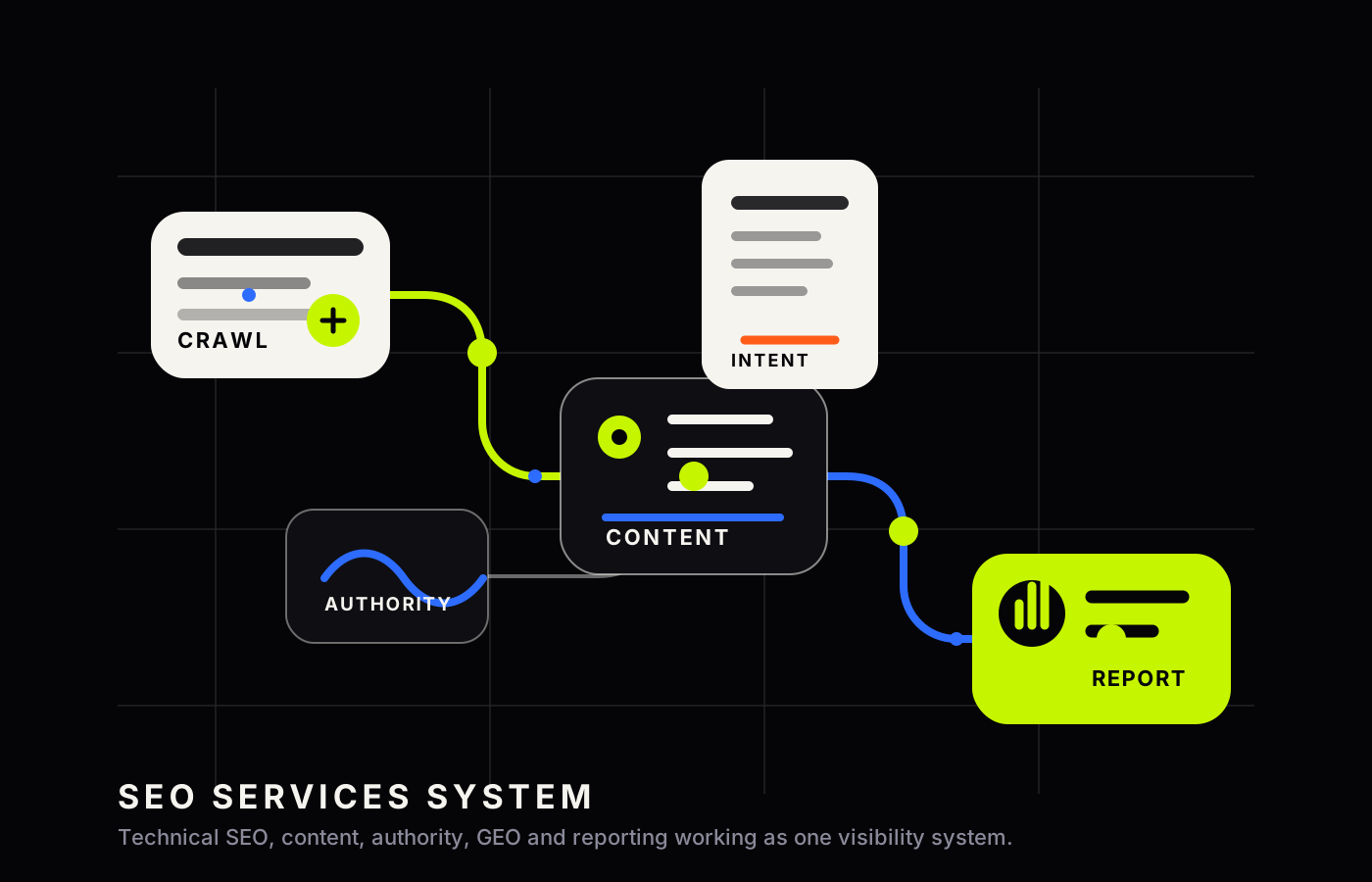
SEO services should do more than add keywords to pages. For a UK business, a proper SEO programme should improve how search engines crawl, understand, trust, rank, and cite the brand. It should also prepare the site for AI answer engines, where buyers now compare suppliers before they ever click a traditional search result.
Kay & Co. is a UK SEO and GEO optimisation consultancy. We help brands improve visibility in Google and Bing, then build the entity signals, content structure, and authority needed to appear across AI search surfaces such as ChatGPT, Perplexity, Gemini, Copilot, and Google AI Overviews. This guide explains what good SEO services should include, what to question in a proposal, and where modern SEO now overlaps with GEO.
SEO services start with commercial goals
The best SEO services begin with business context, not a spreadsheet of keywords. A strong SEO partner should understand what the business sells, which services have the best margins, which audience segments matter, and what a qualified lead or sale is worth.
For Kay & Co., SEO strategy starts by mapping search demand to commercial value. A page that ranks for a low intent informational query may bring traffic, but it may not create revenue. A page that ranks for a commercial term such as "seo services", "seo consultant", or "seo agency UK" is more likely to influence a buying decision.
A proper discovery process should define:
- Primary services, locations, sectors, and audience types.
- Current organic traffic, rankings, leads, and conversion paths.
- Priority products or services for the next six to twelve months.
- Competitors in Google, Bing, and AI answer engines.
- Content gaps, technical risks, and authority weaknesses.
Technical SEO is the foundation
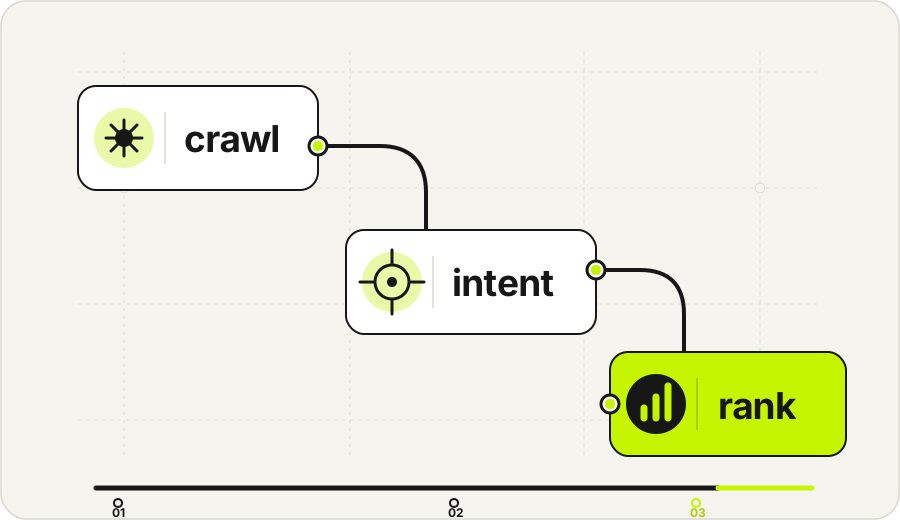
Technical SEO is the part of SEO services that makes a site crawlable, indexable, fast, and understandable. If the technical foundation is weak, content and links have less impact because search engines may struggle to process the site correctly.
A technical SEO audit should include crawl errors, redirect chains, canonical tags, XML sitemaps, robots.txt rules, page speed, mobile usability, structured data, duplicate pages, broken links, and index coverage. For larger sites, it should also assess faceted navigation, pagination, JavaScript rendering, international targeting, and crawl budget.
For a UK service business, technical work often includes cleaning up extensionless URL signals, improving Core Web Vitals, tightening internal links, and making sure important service pages are easy for search engines to find. These changes are not glamorous, but they are the difference between a site that looks good and a site that can actually rank.
Any SEO provider should be familiar with Google's guidance on creating helpful, reliable, people-first content. Technical SEO should support that goal by making helpful pages easier to discover, render, and interpret. It should not be used to hide thin content, manipulate crawlers, or create a version of the site that is different from what users see.
Keyword research needs intent, not just volume
Keyword research is still part of SEO services, but it should not be treated as a list of terms to repeat. The important question is intent. What is the searcher trying to do, and what page would genuinely satisfy that need?
High volume terms can be useful, but they are not always the best commercial target. A phrase such as "seo services" has broad demand, while a phrase such as "technical SEO consultant for SaaS" may have lower volume but stronger buying intent. A good SEO strategy balances both.
Modern keyword research should group terms into topics and page types:
- Commercial pages: service pages, comparison pages, pricing pages, and location pages.
- Informational pages: guides, definitions, checklists, and educational resources.
- Authority pages: original research, case studies, tools, and expert commentary.
- AI citation pages: concise, structured, factual pages that answer specific buyer questions.
This structure helps both search engines and AI answer engines understand what the brand does and when it should be surfaced.
Content strategy should build topical authority
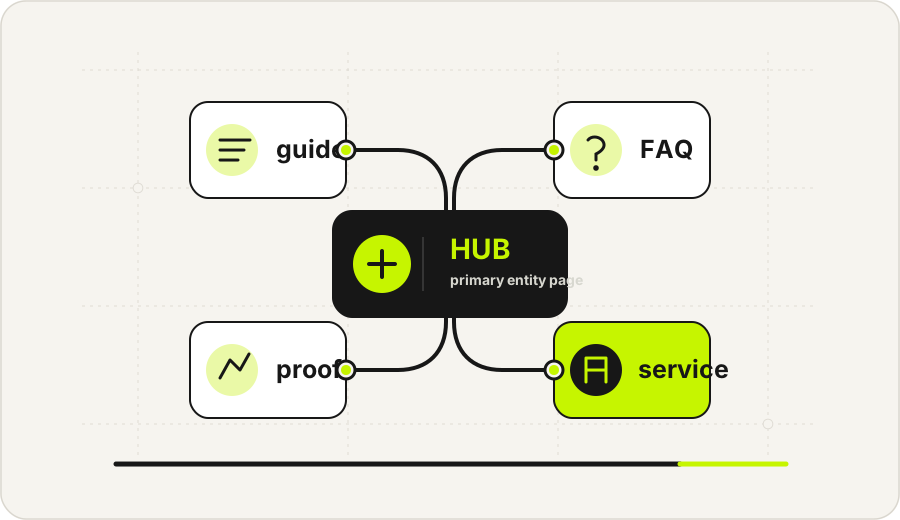
Good SEO services include content strategy, not just content production. Publishing random articles is not the same as building topical authority. A content strategy should define the topic clusters a brand needs to own, the pages required inside each cluster, and the internal links that connect them.
For example, a business selling SEO services may need a commercial service page, a technical SEO guide, a local SEO guide, a comparison page for agency versus consultant, a schema markup resource, and a page explaining how AI search optimisation fits into organic strategy. Each page should answer a distinct intent and link naturally to related pages.
Kay & Co. writes content for both ranking and citation. That means content should be clear, factual, well structured, and easy to extract. Headings should answer real questions. Paragraphs should define entities precisely. Claims should be specific. Pages should make it obvious who the author is, what the organisation does, where it operates, and why it is credible.
Authority building still matters
Backlinks remain a strong signal of trust and authority. SEO services should include a plan for earning relevant links, but the method matters. Low quality directories, link farms, and private blog networks can damage long term visibility. A credible SEO partner should be able to explain exactly how links are earned.
Strong authority building usually comes from digital PR, expert commentary, useful resources, partnerships, and content that deserves citation. For UK businesses, this may include industry publications, local business coverage, trade bodies, podcasts, interviews, data-led reports, and supplier or partner pages.
Authority is not only about links. AI search systems also rely on entity consistency. Your brand name, services, location, author profiles, social profiles, company descriptions, and third party mentions should tell the same story across the web. This is where SEO, digital PR, and GEO start to overlap.
On-page SEO should make every important page clearer
On-page optimisation is often misunderstood as adding keywords to headings and meta tags. That is only a small part of the work. Good on-page SEO services make every important page easier for search engines, AI systems, and human visitors to understand.
A service page should clearly state what the company offers, who it serves, where it operates, and what problem it solves. It should include a strong H1, useful H2 sections, precise page titles, concise meta descriptions, internal links, relevant FAQs, and proof points such as case studies, reviews, accreditations, or named expertise.
For a UK company buying SEO services, on-page work should also cover search intent. A visitor searching for "seo services" is probably comparing providers, checking what is included, and trying to judge whether the investment is credible. A page that only describes generic benefits will struggle. A page that explains process, deliverables, outcomes, and next steps will be more useful.
On-page SEO should also remove ambiguity. If a business offers SEO audits, technical SEO, content strategy, local SEO, digital PR, and GEO, each service should have a clear place in the site architecture. Search engines reward clarity because clarity helps users.
Local and national SEO need different tactics
Not every campaign needs the same SEO services. A local trades business, a professional services firm, an e-commerce brand, and a national B2B consultancy all have different search problems. The strategy should reflect that.
Local SEO services usually focus on Google Business Profile optimisation, local landing pages, reviews, local citations, local links, location relevance, and map pack visibility. A local campaign should connect search demand to specific towns, cities, or service areas. It should also make it easy for customers to call, book, or request a quote.
National SEO services usually require broader topical authority, stronger content depth, more competitive link acquisition, and tighter technical architecture. National campaigns often need comparison pages, thought leadership, category pages, and original resources that can earn links and citations over time.
Kay & Co. focuses on UK visibility, so we look at both layers. Some clients need local proof and service area relevance. Others need national authority and AI citation readiness. The right mix depends on the market, not on a fixed package.
GEO should now be part of SEO services
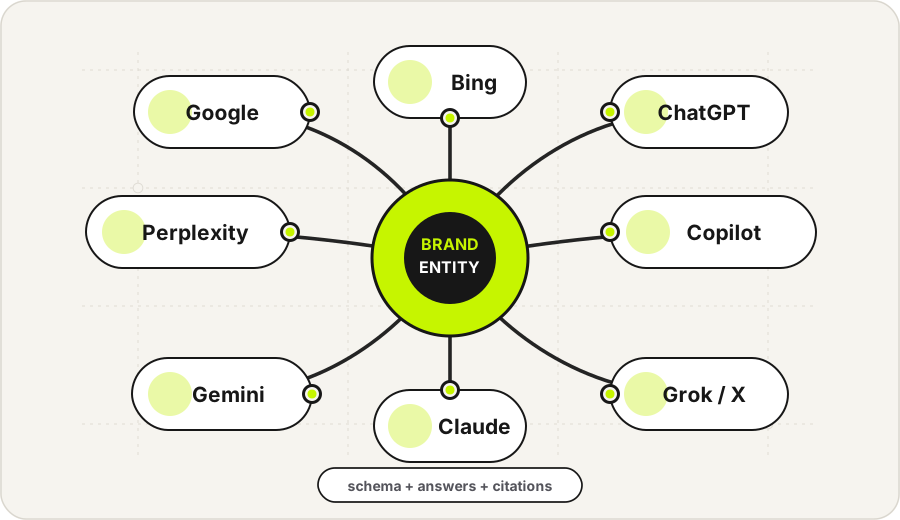
GEO, or Generative Engine Optimisation, is now a serious part of organic visibility. Customers no longer only search Google and click blue links. They ask ChatGPT, Perplexity, Gemini, Copilot, and Google AI Overviews for recommendations, summaries, comparisons, and explanations.
SEO services should therefore include GEO readiness. That means structured content, clear entity relationships, schema markup, FAQ sections, citation-friendly definitions, and pages that directly answer buyer questions. It also means monitoring whether the brand is being cited by AI answer engines, not only whether it ranks in Google.
Useful GEO work includes:
- Creating concise answer sections for high intent questions.
- Strengthening author and organisation signals.
- Using structured data where it genuinely describes the page.
- Building entity-rich pages around services, locations, and expertise.
- Improving third party mentions and consistent brand descriptions.
Kay & Co. treats GEO as an extension of SEO because both disciplines rely on clarity, authority, and useful content.
Measurement and conversion tracking are not optional
SEO services should include measurement from the beginning. Without tracking, a business cannot tell whether rankings are producing enquiries, calls, sales, or pipeline. Traffic growth is useful, but traffic without commercial movement is not enough.
A proper measurement setup should connect Google Search Console, analytics, call tracking where appropriate, form submissions, CRM data, and conversion events. For e-commerce, it should connect organic search to revenue. For lead generation, it should connect organic traffic to qualified enquiries and sales conversations.
Measurement should also separate brand and non-brand search. Brand traffic is valuable, but it does not always prove that SEO services are expanding demand. Non-brand growth shows whether the site is reaching new people who did not already know the company.
For GEO, measurement is still developing. Kay & Co. tracks AI visibility by checking whether the brand appears in answer engines for priority prompts, whether competitors are being cited instead, and which pages or sources are being used. This gives clients a clearer view of visibility beyond traditional rankings.
What a monthly SEO services plan should contain
A monthly SEO services plan should be specific enough to manage, but flexible enough to respond to new data. If the plan is identical every month, it is probably not being guided by performance. Search behaviour changes, competitors publish new pages, Google updates systems, and AI answer engines shift the sources they rely on.
A useful monthly plan should include a clear priority list. For example, month one may focus on technical fixes and measurement. Month two may focus on service page improvements. Month three may introduce new content clusters and authority building. Later months may move into content refreshes, conversion improvements, and GEO monitoring.
For most UK businesses, monthly SEO services should contain a mix of strategy, execution, and review. Strategy decides what matters. Execution gets the work live. Review checks whether the work moved the right numbers. Removing any one of those layers makes the campaign weaker.
Kay & Co. prefers visible work over vague activity. A client should know which pages were changed, which pages were published, which technical issues were fixed, which links or mentions were earned, and which decisions were made because of the data. That level of clarity makes SEO services easier to judge and easier to improve.
Reporting should link SEO to business outcomes
SEO reporting should not be a decorative PDF full of ranking screenshots. A useful report should explain what changed, why it changed, what was done, what it means commercially, and what happens next.
A serious SEO services report should include:
- Organic traffic by landing page and query theme.
- Ranking movement for priority commercial keywords.
- Conversions, enquiries, assisted conversions, and revenue where tracking exists.
- Technical health, crawl issues, page speed, and indexation changes.
- New content published and content refreshed.
- Links earned and authority improvements.
- AI visibility observations, including citations and brand mentions where available.
The report should also include clear decisions. SEO is not only measurement. It is strategy. A good partner will use data to decide what to fix, what to publish, what to consolidate, and where to invest next.
What to avoid when buying SEO services
Some SEO services look attractive because they sound simple. In practice, the simplest packages are often the least useful. A fixed bundle of ten backlinks, four blogs, and one report per month may be easy to buy, but it does not mean the work matches the site's real problem.
Avoid providers that guarantee number one rankings, refuse to explain link sources, publish low quality AI content without editorial review, or report only vanity metrics. Also be careful with agencies that talk about "AI SEO" without explaining how they build entity clarity, structured data, source trust, and citation-worthy pages.
You should also avoid any SEO partner that cannot prioritise. A good audit will find many issues, but not every issue matters equally. The value is in deciding what to fix first. For some sites, technical indexation is the urgent problem. For others, weak service pages, thin content, or lack of authority are the real blockers.
Good SEO services should feel like a strategic operating system for visibility. They should make the site easier to crawl, easier to understand, easier to trust, and easier to choose. That is the standard UK businesses should expect.
Frequently asked questions
SEO services should include technical SEO, keyword and intent research, content strategy, on-page optimisation, authority building, structured data, reporting, and a clear plan for improving visibility across Google, Bing, and AI answer engines.
UK SEO services vary by scope, competition, and execution level. Small local campaigns may start from a few hundred pounds per month, while competitive national or B2B campaigns often require larger monthly retainers because they need technical work, content, links, and strategic oversight.
Yes. For brands that rely on organic discovery, SEO services should now include GEO, or Generative Engine Optimisation, because customers increasingly use AI answer engines such as ChatGPT, Perplexity, Gemini, Copilot, and Google AI Overviews to compare suppliers and make decisions.
Technical improvements can show early gains within weeks, but meaningful organic growth usually takes three to six months. Competitive terms, new sites, weak authority, and thin content can extend the timeline.